Chiesa di Santo Spirito ed ex convento dell’Ordine dei Frati Minimi di San Francesco di Paola – Church of Santo Spirito and former convent of the Order of Friars Minimi of San Francesco di Paola
Chiesa costruita su un preesistente insediamento di monache benedettine dell'XI secolo, a ridosso delle mura etrusche
Church built on a pre-exhisting settlement of Benedictine nuns of the XI century, close to the Etruscan walls
Descrizione
Nell’area dove è sorta la chiesa, esisteva già dall’ XI sec. un insediamento di monache benedettine, a ridosso delle mura etrusche. Dal XV sec. l’edificio fu ceduto all’Ordine dei Minimi di Paola
Nel 1798 durante la Repubblica Giacobina il convento venne soppresso.
Dopo la Restaurazione i Minimi vi tornarono fino all’Unità d’Italia.
Nel 1861 con il decreto Pepoli, passò definitivamente al Demanio, divenendo sede della prima scuola pubblica cittadina per l’infanzia (1863) e poi dell’Istituto Magistrale Assunta Pieralli, oggi Liceo Pedagogico.
Anche la chiesa fu incamerata dallo Stato, per divenire magazzino dell’esercito.
Dopo 50 anni fu riconsacrata come parrocchia, acquisendo anche il titolo e i beni della vicina chiesa di San Giacomo delle cinque piaghe.
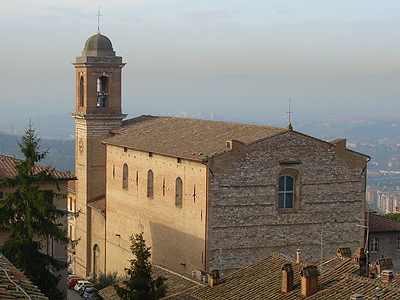
La chiesa fu ricostruita in stile classico, dal 1579 al 1689, su disegno di Francesco Vezzosi da Pistoia, con un impianto a croce latina ad un’unica navata, divisa in tre campate, con volta a botte.
La facciata, a capanna, non è stata mai completata nel rivestimento.
Il campanile, coperto da una cupoletta poligonale, fu realizzato nel XIX sec., in sostituzione di quello antico a vela, visibile ancora in alcune stampe.
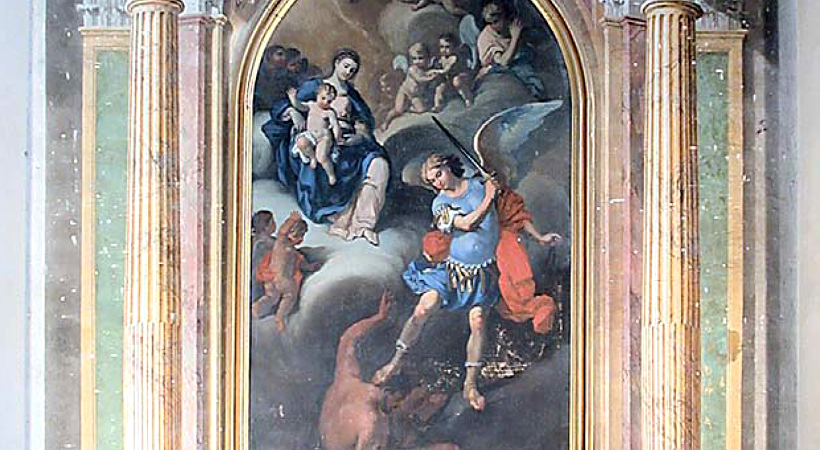
L’interno conserva negli altari numerose tele del XVIII sec. scampate alle requisizioni napoleoniche e alle demanializzazioni post-unitarie.
Due tele sono incorniciate da finte architetture prospettiche di Pietro Carattoli (XVIII sec.).
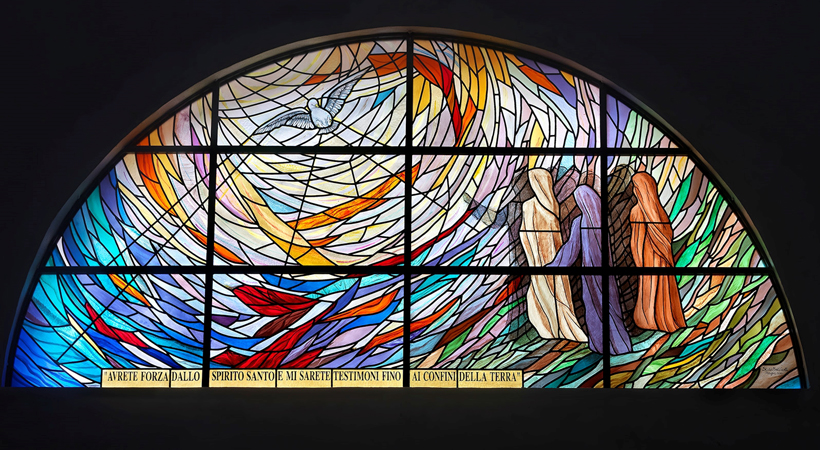
Le vetrate policrome sono state realizzate, nel 1954 e nel 2011, dallo storico laboratorio perugino Moretti-Caselli.
__________________________
In the area where the church was built, a settlement of Benedictine nuns already existed since the XI century. From the XV century, the building was sold to the Order of Minimi of Paola.
In 1798, during the Jacobin Republic, the convent was abolished. After the Restoration, the “Minimi” returned there until the Unification of Italy in 1861. With the Pepoli decree, it definitively became State Property, becoming the site of the city’s first public school for children (1863) and then the site of the Magistrale Assunta Pieralli Institute, today a Pedagogical High School. Also the church was taken by the state and transformed into an army warehouse. After 50 years it was again consecrated as parish, gaining the title and goods of the close church of San Giacomo delle cinque piaghe.
From 1579 to 1689, the church was rebuilt in a classical style designed by Francesco Vezzosi da Pistoia, with a Latin cross plan with a single nave, divided into three bays, with a barrel vault. The gabled façade was never completed in the lining.
The bell tower, covered by a small polygonal dome, was built in the XIX century, replacing the antique sail, still visible in some prints. Inside the altars, many paintings from the XVIII century escaped from the Napoleonic requisitions and the post-unitary de-nationalisations. Two paintings are framed by fake perspective architectures by Pietro Carattoli (XVIII century).
The polychrome glass windows were made, in 1954 and 2011, by the historic Perugian laboratory Moretti-Caselli.
Galleria di immagini
Modalità di accesso
Accessibile a persone con disabitilità motoria
__________________________
Wheelchair accessible
Dove
Indirizzo
CAP
Orari di apertura
Per orari consulta i contatti che trovi su ulteriori informazioni
__________________________
For opening hours see ulteriori informazioni
Contatti
Ulteriori informazioni
Info
Parrocchia Santo Spirito
+39 075.5720731
saulosantospirito@gmail.com
www.santospiritoperugia.it