Palazzo della Provincia e della Prefettura – Province and Prefecture Palace
La sede del Governo nata sui resti della Rocca Paolina
The seat of the provincial government built over the remains of the fortress Rocca Paolina
Descrizione
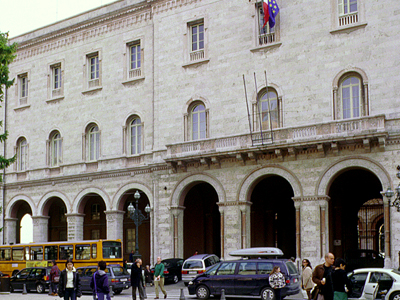
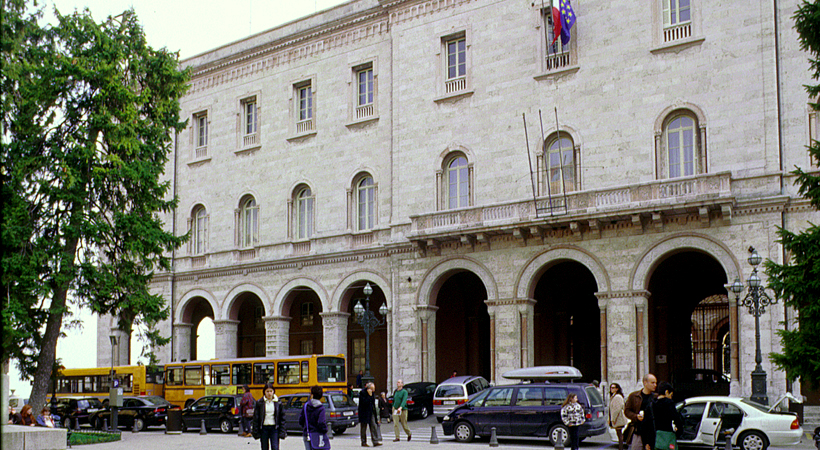
Costruito dopo l’unità d’Italia sulle rovine della Rocca Paolina, la grande fortezza papale. Il progetto del palazzo, del 1867, è del milanese Alessandro Arienti, ingegnere capo del Comune di Perugia.L’edificio, con porticato su tutto il perimetro, riprende lo stile dei palazzi pubblici dell’Italia settentrionale, integrato con la bicromia umbra bianco-rosa data dall’uso delle pietre locali. Le decorazioni interne (1870-75) si devono a Domenico Bruschi, Mariano Piervittori, Matteo Tassi, Giovanni Panti, Marzio Cherubini e Nicola Benvenuti.Le simbologie dei suoi cicli pittorici sono dedicate ai temi dell’Unità d’Italia e a citazioni di storia locale. Al piano nobile si trova la sala del Consiglio a pianta ottagonale progettata dallo stesso Arienti e decorata da D. Bruschi.Dal 1985 la Provincia è titolare della collezione Straka-Coppa, che al momento non è visitabile.
______________________________
The Province and Prefecture Palace was built after the unification of Italy over the ruins where the great papal fortress, the Rocca Paolina, once stood. It was designed in 1867 by the architect Alessandro Arienti from Milan, the chief engineer of the city of Perugia.
The building, with porticoes all around it, reflects the style of the public buildings of northern Italy and is faced with the typical Umbrian white and pink stone. The interior decorations (1870-75) were done by Domenico Bruschi, Mariano Piervittori, Matteo Tassi, Giovanni Panti, Marzio Cherubini and Nicola Benvenuti.The symbolism of the painting cycles are dedicated to the themes of the Unification of Italy and events of local history. On the main floor there is the octagonal Council Chamber, also designed by Arienti and decorated by Domenico Bruschi.
Since 1985, the Province has been the owner of the Straka-Coppa collection, which at the moment is not open to the public.
Galleria di immagini
Modalità di accesso
Ingresso gratuito, su appuntamento. Prenotazione visita presso lo sportello del Cittadino della Provincia.
Accessibile ai disabili
______________________________
Free entrance upon reservation at the nearby “sportello del Cittadino” della Provincia
Wheelchair accessible
Dove
Indirizzo
CAP
Orari di apertura
Per orari consulta i contatti che trovi su ulteriori informazioni
__________________________
For opening hours see ulteriori informazioni
Contatti
Ulteriori informazioni
Info
Info: Sportello del Cittadino N. verde +39 800 013474
email: urprov@provincia.perugia.it
sito: www.provincia.perugia.it