Mosaico Romano di Santa Elisabetta – Roman Mosaic of Santa Elisabetta
I resti di un complesso termale romano
The remains of a Roman bath complex
Descrizione
Il mosaico romano di Santa Elisabetta, risalente agli inizi del II sec. d.C., fu scoperto nel 1875 nel luogo dove sorgeva la chiesa medievale di Santa Elisabetta.
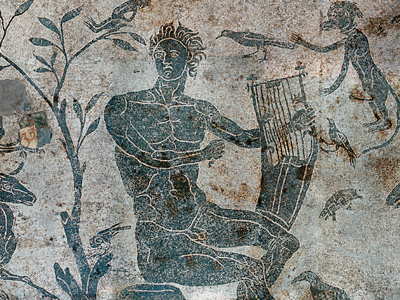
Ordinato a tessere bianche e nere, rappresenta il mito di “Orfeo e le fiere”: il mitico cantore greco suona la cetra circondato da quaranta animali disposti su file parallele, che avanzano attratti dalla sua musica.
Il mosaico apparteneva probabilmente ad un complesso termale della Perugia romana. In età cristiana su di esso venne costruita la Chiesa, della quale restano le mura perimetrali.
______________________________
The Roman mosaic of Santa Elisabetta, from the early II Century A.D., was discovered in 1875 in the place where the medieval church of Santa Elisabetta stood.
It represents ‘Orpheus and the Beasts’ organised in black and white tesserae: the legendary Greek musician plays his lyre, surrounded by forty animals in parallel rows, which approach him attracted by his music.
The mosaic was probably part of a Roman bath complex in Perugia. In the Christian era the church of Sant’Elisabetta was built over it and the perimeter walls of the church still remain.
Galleria di immagini
Modalità di accesso
Accessibile a persone con disabitiltà motoria
______________________________
Wheelchair accessible
Dove
Indirizzo
entrance of the University of Perugia, Department of Mathematical, Physical and Nat. Sciences
CAP
Orari di apertura
lunedì-venerdì 8:00-19:00
Chiuso: sabato, domenica e festivi
______________________________
Mondays – Fridays h. 8:00 am – 7:00 pm
Closed: Saturdays, Sundays and Bank Holidays
Contatti
Ulteriori informazioni
Info
Info: tel. +39 075 5855604-5
sito: www.perusia.unipg.it/mosaic.htm