Cappella di San Severo – Chapel of San Severo
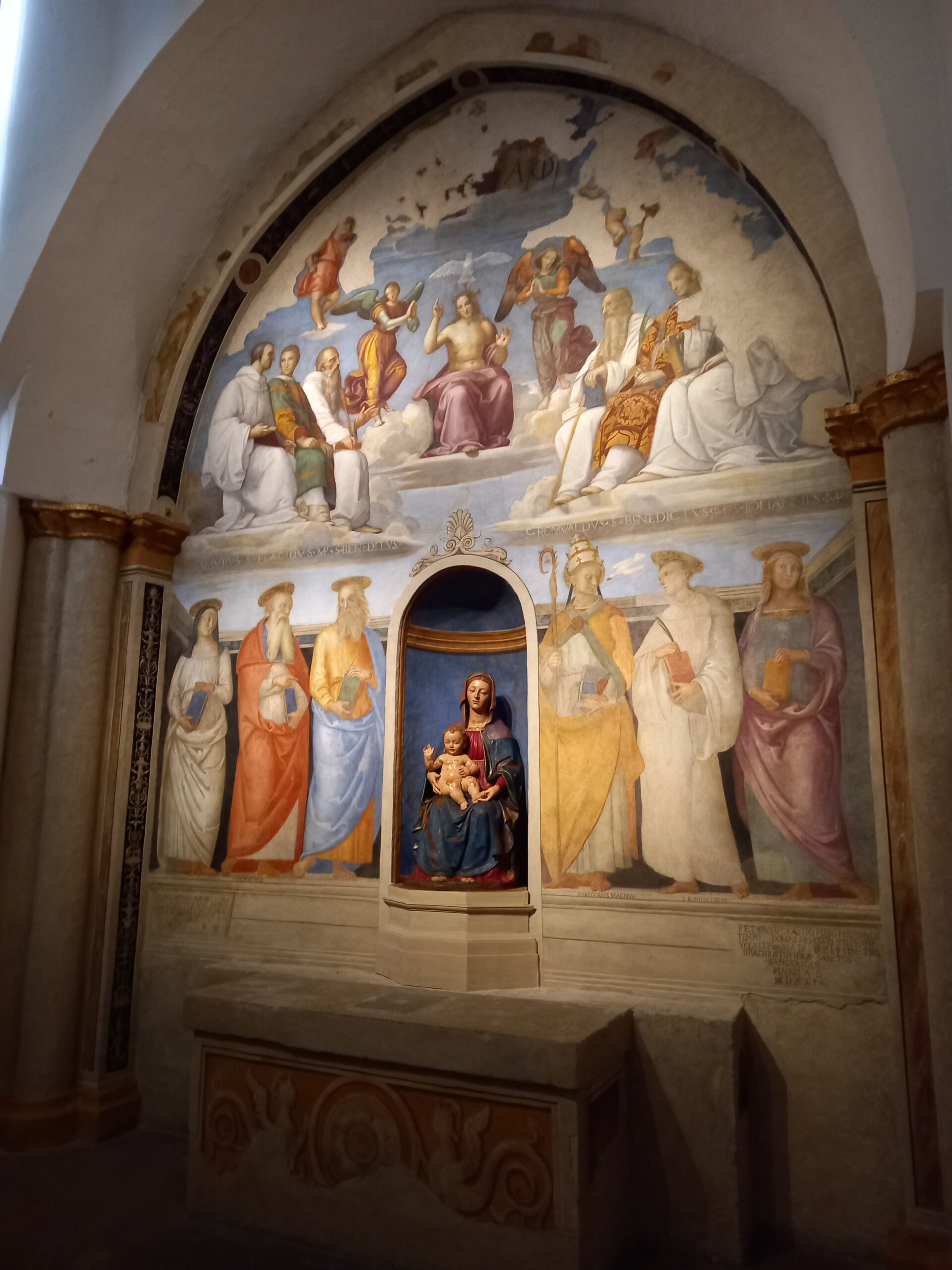
Al suo interno l’unica opera di Raffaello rimasta in città: l’affresco Trinità e Santi benedettini e camaldolesi
Here the only remaining work by Raffaello in Perugia: the fresco Trinity and Benedectine and Camaldolesi Saints
Descrizione
La Cappella, risalente al XV secolo, è attigua all’attuale chiesa e al convento occupati dai Camaldolesi fin dal XII secolo.
Collocata nel Rione di Porta Sole, è ciò che rimane della chiesa cinquecentesca, ricostruita e ampliata nel Settecento.
Al suo interno si conserva l’affresco eseguito da Raffaello Sanzio, commissionato dai monaci camaldolesi e realizzato tra il 1505 e il 1508, la cui parte superiore raffigura la Trinità, circondata da angeli e cherubini e affiancata da santi dell’ordine camaldolese e benedettino. Chiamato a Roma da Papa Giulio II per realizzare le Stanze Vaticane, Raffaello non porterà mai a termine l’opera a causa della prematura morte, avvenuta nel 1520. Al suo posto, l’ordine camaldolese chiamerà Pietro Vannucci, detto Perugino, che la concluderà con l’aggiunta di una teoria di Santi nel registro inferiore.
Al centro dell’affresco è collocata una Madonna con Bambino in terracotta policroma attribuita a Leonardo Del Tasso, che riprende lo stile della scuola fiorentina. L’affresco di San Severo è il dialogo attraverso il tempo tra due dei maggiori esponenti del Rinascimento italiano, nel quale la grazia del Vannucci convive con la potenza espressiva del giovane Raffaello che, proprio in quegli anni, approdava a un realismo e a una corporalità capace di coniugare il racconto sacro con una nuova sensibilità, sintesi perfetta dell’umanesimo-rinascimentale. Si tratta dell’ultima opera realizzata nel capoluogo umbro da Perugino, che sarebbe morto di lì a due anni, nonché dell’unica rimasta in città eseguita da Raffaello.
_________________________________
The Chapel of San Severo, first built in the XV Century, is adjacent to the church and convent of the Camaldolesi, present since the XII Century. Inside the District of Porta Sole, it’s all that remains of the XBVI Century Church, rebuilt and enlarged in the XVII Century.
Inside the chapel, commissioned by the Camaldolesi Friars, is a fresco painted by Raffaello Sanzio, between 1505 and 1508, the upper part of which portrays the Trinity, surrounded by angels and cherubim and sided by saints of the order. Called to Rome by Pope Giulio II to the painting of the Vatican Rooms, Raffaello will never finish this work, due to his premature death, in 1520. In his stead the Order called Pietro Vannucci, also Known as Perugino, who concluded the fresco with a theory of Saints in the inferior part. At the centre of the fresco a Madonna with Child in polychromic terracotta attributed to Leonardo Del Tasso, inspired by the Florentine school.
The Fresco of San Severo is a dialogue through time between two of the most important exponents of Italian Renaissance, in which the grace of Vannucci lives together with expressive power of the young Raffaello, who, right in those days, was getting to a realism and a corporeity enabling the sacred telling to exist in a new sensibility, a perfect synthesis of the renaissance humanism.
It is the last artwork made in Perugia by Perugino, who died after only two years, and the only one remaining in town by Raffaello.
Galleria di immagini
Modalità di accesso
– gruppi di minimo 10 persone
– Forze armate e Comparto Sicurezza e Difesa
– dipendenti del Ministero della Cultura (MiC) (su presentazione del tesserino)
– dipendenti del Comune di Perugia (su presentazione del badge)
– studenti, dottorandi, ricercatori e docenti di Architettura, Archeologia, Storia dell’arte, Beni Culturali,
Scienze dell’Educazione e altri corsi caratterizzati dalla classe di insegnamento L-ART 01,02, 03 e 04, dei
Conservatori/Accademie di Musica e di Belle Arti (con libretto accademico o altra documentazione che ne
certifichi l’iscrizione)
– possessori del biglietto “Civitas Perusina” (itinerario nelle sale di Palazzo dei Priori, del Nobile Collegio del Cambio, del Nobile Collegio della Mercanzia)
– convenzioni in vigore
– per attività di valorizzazione organizzate/promosse dall’Amministrazione anche in collaborazione con il gestore
– scolaresche di ogni ordine e grado
– convenzioni in vigore
– per attività di valorizzazione organizzate/promosse dall’Amministrazione anche in collaborazione e/o per il tramite del gestore
– insegnanti accompagnatori di scolaresche
– direttori e funzionari di musei pubblici e privati (su presentazione di tesserino o badge)
– dirigenti del Ministero della Cultura (MiC) in servizio
– guide turistiche, con licenza riconosciuta
– disabile e n. 1 accompagnatore
– giornalisti/Pubblicisti (con tesserino dell’Ordine o lettera d’incarico firmata dal Direttore)
– convenzioni in vigore
– per attività di valorizzazione organizzate/promosse dall’Amministrazione anche in collaborazione e/o per il tramite del gestore
_________________________________
Entrance:
Ticket € 4,00;
Reduced ticket A €2,00
senior over 65 years – groups of minimum 15 people;
Reduced B € 1,00 – 7 to 14 years old, schools;
Free – 0 to 6 years
wheelchair accessible
Dove
Indirizzo
CAP
Orari di apertura
______________________________
Opening hours:
January, February, March, November and December: h. 11:00 am – 1:30 pm / 2:30 pm – 5:00 pm – Monday closed
May, September and October: h. 10:00 am – 1:30 pm / 2:30 pm – 6:00 pm – Monday closed
June and July: h. 10:00 am – 6:00 pm – Monday closed
April: h. 10:00 am – 1:30 pm / 2:30 pm – 6:00 pm – all days
Agosto: h. 10:00 am – 6:00 pm – all days
Contatti
Ulteriori informazioni
Info
Le Macchine Celibi soc. coop.
+39 389 1116152 – +39 075 3745273
www.lemacchinecelibi.coop
www.facebook.com/lemacchinecelibi
info.perugia@lemacchinecelibi.coop